
Introduction
Have you ever searched for something on Google and clicked a result on Page 2?
Take a moment. Think about it honestly. The answer, for most people, is almost never. Research by Backlinko confirms what most of us already know instinctively, the first result on Google gets 27.6% of all clicks. By the time you reach Page 2, you are fighting for scraps.
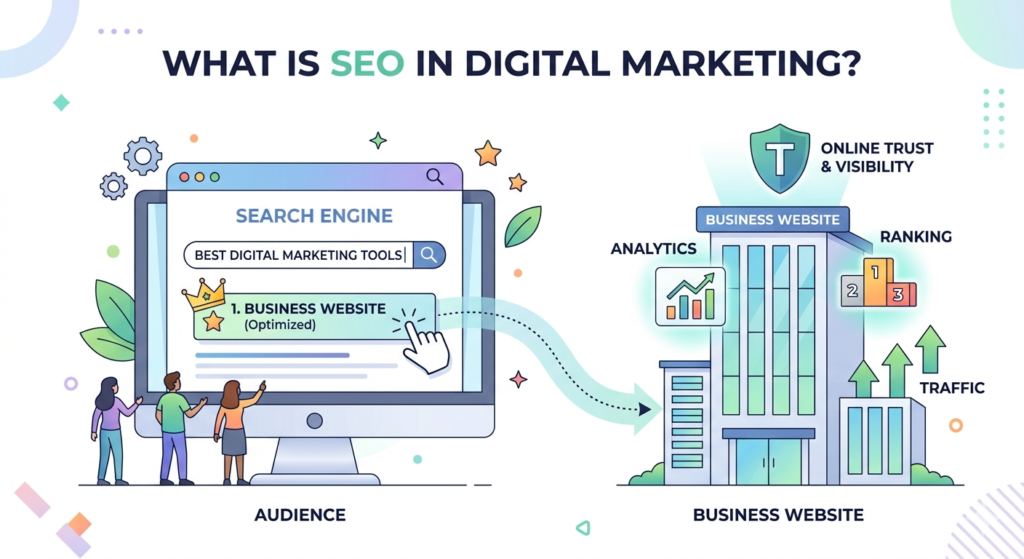
Now here is the uncomfortable truth. Most businesses, most websites live on Page 2. Or Page 5. Or Page 20. Not because their products are bad. Not because their content is uninteresting. But because they have never truly understood what is SEO in digital marketing means, beyond a handful of buzzwords they heard at a conference.
This blog is for anyone who has heard “you need to do SEO” a hundred times but never had someone sit down and explain it in plain, honest, human language. By the time you finish reading this, you will not just understand SEO you will know exactly how to start using it. Let us begin.
What Is Search Engine Optimization? And What It Is NOT
Before we talk about what SEO is, let us quickly clear the air about what it is not.
SEO is not about tricking Google. It is not about stuffing your content with keywords until it reads like a robot wrote it. It is not a one-time task you do when you launch a website and forget about. And it is not something that works overnight.
Now, what is SEO in digital marketing actually is –
Search Engine Optimization is the art and science of convincing search engines like Google to recommend your website content as the best solution to a particular user’s search query.
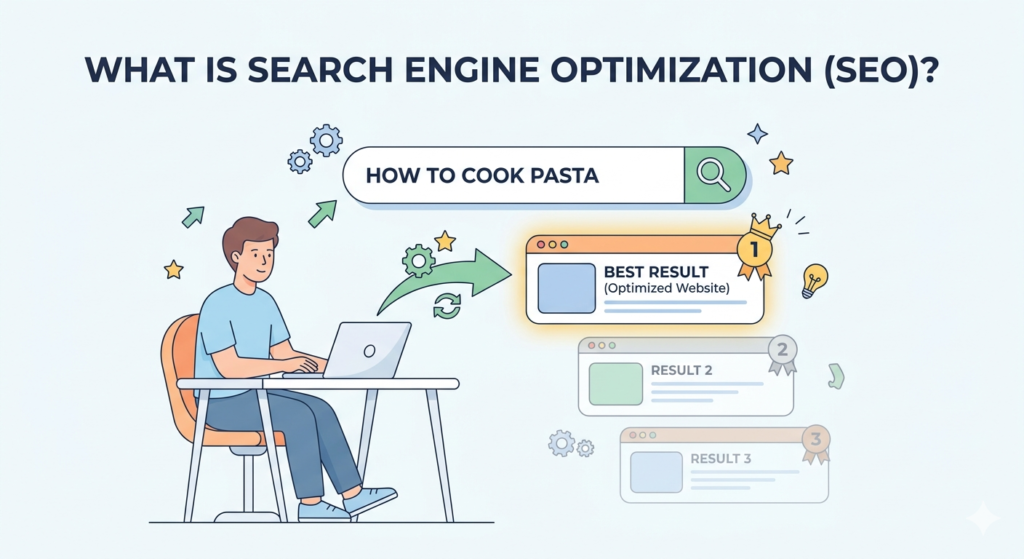
The keyword here is “recommend.” Google is not a neutral directory. It is an active recommender. Every time someone searches something, Google looks at every relevant webpage on the internet and makes a judgment call: which of these pages would I most confidently send this person to?
SEO is the process of making Google confidently choose you.
Here is a beautiful way to think about it. Imagine you are a doctor. When a patient comes to you with a symptom, you do not guess you examine them, diagnose them and recommend the best treatment. Google does the same thing with web pages. When a user comes with a query, Google examines all available pages and recommends the one it believes will best solve that person’s problem.
Your job is to be the page Google recommends. That is SEO. In its entirety.
What Are the 3 Pillars of SEO? The Foundation You Cannot Build Without
People often imagine SEO as one big thing, you either have it or you do not. But SEO is actually three distinct disciplines working in harmony. Remove any one of them and the whole structure becomes unstable.
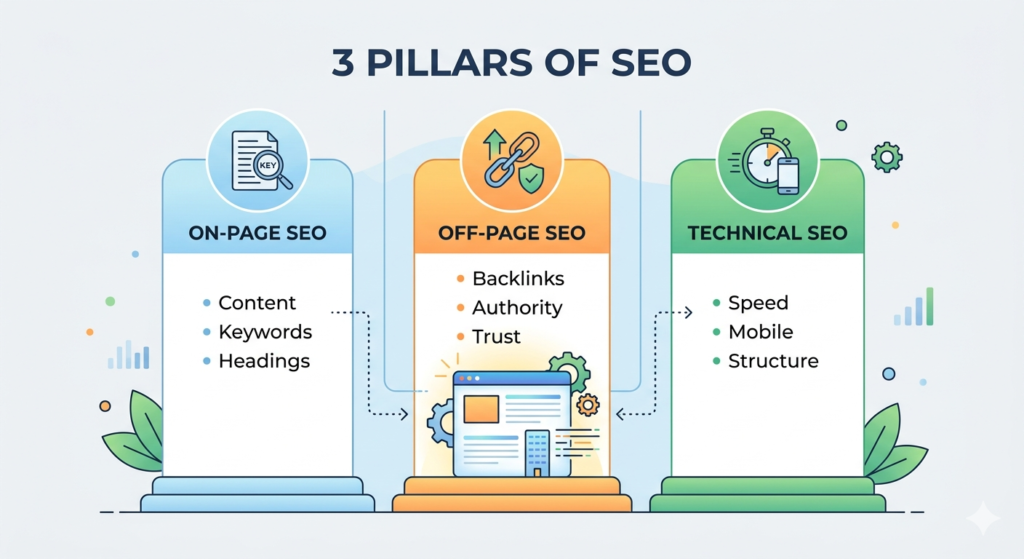
Pillar 1 – On-Page SEO: The Words You Choose and How You Use Them
On-Page SEO is the work you do directly within your website: the content you create, the keywords you use, the structure of your pages and how clearly you signal to Google what each page is about.
Think of it this way. Every page on your website is an employee representing your brand at a job interview with Google. On-Page SEO is the coaching you give that employee on how to introduce themselves, how to explain what they do, what examples to use, how to answer Google’s questions in a way that gets them hired for the top search result.
Specifically, On-Page SEO involves choosing the right keywords based on what your target audience is searching, placing those keywords strategically in your headings and content, writing content that genuinely and thoroughly answers the user’s question, optimising your page title and meta description and making sure your images are described clearly for Google’s bots to understand.
Here is a personal insight: the biggest On-Page SEO mistake beginners make is writing for Google first and humans second. The moment you start writing for algorithms rather than real people, your content becomes stiff, unnatural and actually less likely to rank because Google has become sophisticated enough to tell the difference.
Write for humans. Optimise for Google. In that order.
Pillar 2 – Off-Page SEO: What the World Says About You
On-Page SEO is what you say about yourself. Off-Page SEO is what others say about you.
Google places enormous weight on external signals primarily backlinks, to determine how trustworthy and authoritative a website is. A backlink is simply an incoming link from another website pointing to yours. When a credible website links to your content, it is essentially telling Google: “This content is worth reading. I vouch for it.”
Think about how this works in real life. Suppose you want to find a reliable mechanic in a new city. You could read every mechanic’s own website, where they all claim to be excellent. Or you could ask ten people in the city who they trust and let the recommendations guide you. Google does exactly this. It asks the rest of the internet who it should trust.
Other Off-Page signals include social media sharing, when your content gets widely shared, Google notices and unlinked brand mentions, where websites talk about you without necessarily linking to you. All of these signals contribute to your domain authority, your overall reputation in Google’s eyes.
Pillar 3 – Technical SEO: Making Sure Google Can Actually Read You
Here is a scenario many people overlook. You could have the most beautifully written, perfectly keyword-optimised content in the world. But if your website takes 10 seconds to load, is broken on mobile, or has pages that Google’s crawlers cannot access none of that excellent content will ever rank.
Technical SEO is the plumbing of your website. You do not notice it when it is working. But when it is broken, everything else fails.
Technical SEO covers your website’s loading speed, its mobile responsiveness, its security (HTTPS), its sitemap which is like a map you give Google so it knows exactly which pages exist and its crawlability, which is how easily Google’s bots can move through your site and read every page.
A simple test: open your website on your mobile phone right now. Does it load in under 3 seconds? Does it look clean and readable without zooming in? Are the buttons easy to tap? If the answer to any of these is no, that is a Technical SEO problem affecting your rankings today.
What Is the Role of SEO in Digital Marketing?
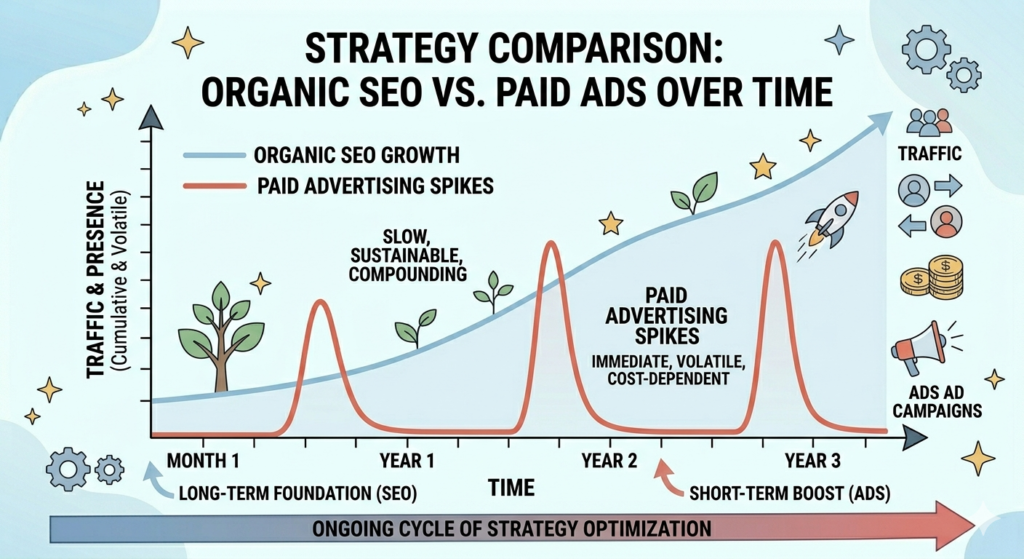
Digital marketing has two broad categories: paid and organic. Understanding the difference between them is fundamental to understanding why SEO matters so much.
Paid marketing – Google Ads, Instagram Ads, Facebook Ads, works like a tap. Turn it on and the water flows. Turn it off and the water stops immediately. The moment your budget runs out, your visibility disappears. Paid marketing is fast, targeted, and powerful but it is perpetually expensive and always temporary.
Organic marketing through SEO works like a well. The digging takes time. The initial investment of effort feels slow. But once that well is deep enough, the water flows consistently whether or not you are actively working on it. The article you write and optimise today can bring visitors to your website every single day for the next five years.
The role of SEO in digital marketing is to be the long-term foundation that everything else builds on top of.
Consider this real-world parallel. A large e-commerce brand spent ₹5 lakh per month on Google Ads for years. They drove excellent traffic and sales but the moment they paused their ads for a single month, their traffic dropped to near zero. Meanwhile, a smaller competitor had been quietly building SEO for two years. When the large brand paused their ads, the smaller brand was ranking organically for every single keyword the larger brand had been paying to appear on. The smaller brand’s traffic cost them almost nothing. Their well was deep.
SEO also plays a supporting role across every other digital marketing channel. Your paid ads become cheaper because your Quality Score improves when your website has excellent SEO. Your social media content gets discovered through search when it is optimized. Your email marketing drives more traffic when the pages you link to are fast and engaging. SEO is not a standalone channel it is the infrastructure that makes every other channel work better.
Objectives of SEO in Digital Marketing
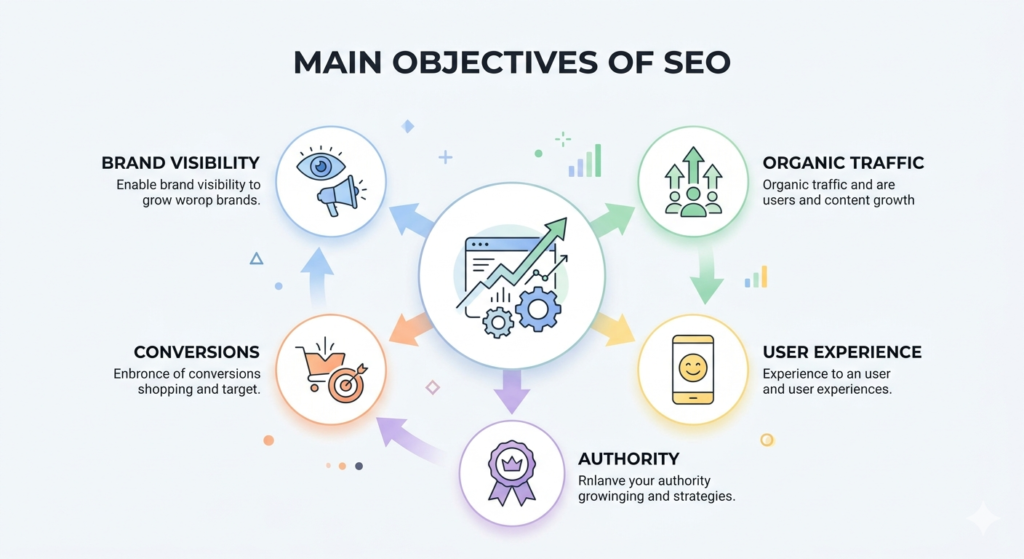
Let us be precise about what is SEO in digital marketing actually trying to achieve. These are the five core objectives and each one is measurable.
Growing your brands online presence
Think about the last time you tried a new restaurant based purely on a Google search. You did not know that restaurant before. But Google showed it to you, you clicked and now you are a loyal customer.
That is brand awareness through SEO. Every time your website appears in a search result even if the person does not click they have seen your brand name. After seeing it three or four times across different searches, something interesting happens: when they finally do need exactly what you offer, your name already feels familiar. Familiarity breeds trust. And trust drives purchase.
Driving High-Quality Organic Traffic
There is a concept in marketing called “intent.” High-intent traffic is traffic from people who are actively looking for something specific. Low-intent traffic is people who stumble across you randomly.
SEO drives almost exclusively high-intent traffic. When someone searches “gut health food delivery in Bangalore,” they are not casually browsing they are actively looking for a solution. If your website appears and provides that solution, conversion is dramatically more likely than with any interruption-based advertising.
Improving User Experience and Website Performance
Here is one of SEO’s most underappreciated benefits: optimising for search engines also makes your website genuinely better for real people. Faster loading. Cleaner navigation. Clearer content. Better mobile experience.
Google rewards websites that users love spending time on. Which means the act of optimising for SEO automatically makes your website a better place for humans too. It is the rare marketing discipline where algorithm optimisation and genuine human value are completely aligned.
Boosting Conversion Rates and Business Growth
Organic traffic converts at a higher rate than most paid traffic not because SEO is magic, but because of that intent factor we discussed. Visitors from organic search are already in “solution mode.” They know they have a problem. They searched for an answer. Your website gave them one. The next natural step is to take action which is exactly the conversion you want.
Establishing Credibility and Industry Authority
Appearing on Page 1 of Google communicates something to users that no advertisement can replicate: Google trusts you. And since most users trust Google implicitly, that trust transfers to you by association.
Over time, as you consistently publish high-quality, optimized content, your website accumulates what SEO professionals call “topical authority”, you become the recognized expert on your subject in Google’s eyes. And experts are who people buy from.
The Benefits of SEO for Your Business
Increased Organic Traffic
The compounding nature of organic traffic is one of SEO’s greatest advantages. Unlike a paid campaign that drives traffic only while it is running, a well-optimised blog post published today continues to drive traffic next month, next year, and potentially for the next decade. The work is done once. The results continue indefinitely.
Enhanced Brand Visibility
Every search result appearance is a free impression. You are not paying to be seen you earned that visibility through the quality of your content. This creates a fundamentally different brand perception than advertising, where the audience knows you paid to be there.
Improved Website Authority
As your content library grows and your backlink profile strengthens, your website’s overall domain authority increases. This creates a compounding advantage – higher authority makes it progressively easier to rank new content, which builds more authority, which makes it even easier to rank. It is the digital equivalent of compound interest.
Targeted Audience Reach
SEO does not broadcast to everyone and hope some percentage is relevant. It places you directly in front of people who are actively searching for your exact product or service at the exact moment they need it. This is the most precise targeting available in any marketing medium.
Cost-Effective Marketing
The initial investment in SEO: time, content creation, technical optimisation feels significant. But amortised over the lifetime of the organic traffic it generates, the cost per visitor from SEO is almost always lower than from any paid channel. And it keeps getting lower over time, while paid costs tend to increase.
Better User Experience
Fast websites. Clear navigation. Helpful content. Mobile-friendly design. These are both SEO requirements and the foundations of excellent user experience. Investing in SEO is investing in making your website genuinely better for every visitor, regardless of how they found you.
Increased Lead Generation
Your website, when properly SEO-optimised, becomes a lead generation machine that works continuously. It captures people in their moment of highest intent when they are actively searching for exactly what you provide and delivers them to your business at any hour of the day.
Data-Driven Insights
The data generated by SEO is extraordinary in its depth. You can see precisely which keywords people use to find you, which pages they love, which pages they leave immediately, where they are located, what devices they use and what content leads them to contact you or purchase. This intelligence makes every other business decision sharper.
How Does Google Rank Pages?
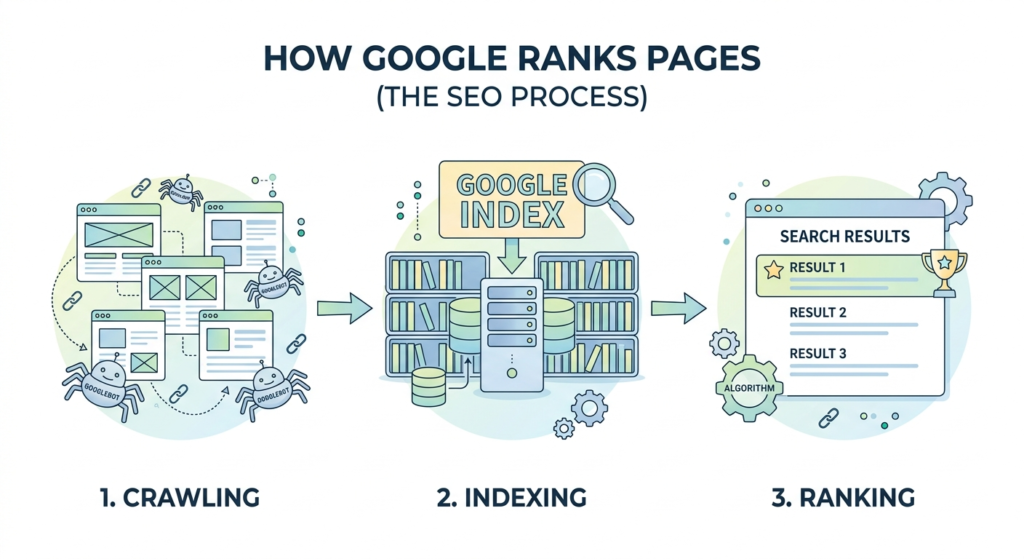
Imagine Google as an extremely demanding, extremely knowledgeable judge at a competition and every webpage on the internet is competing to win. Here is how the judging works.
Step 1 – Crawling. Google sends automated bots across the internet to discover and read web pages. These bots follow links from page to page, reading everything they find. If your page cannot be found or read by these bots due to Technical SEO problems you are disqualified before the competition even begins.
Step 2 – Indexing. After reading your page, Google stores it in its index an enormous database of all the pages it has discovered. Being indexed means you are eligible to appear in search results. Not being indexed means you effectively do not exist in Google’s world.
Step 3 – Ranking. When someone searches something, Google instantly scans its index and ranks all relevant pages according to hundreds of signals. The most important signals are relevance to the search query, the authority of your website based on backlinks, the quality of user experience on your page and how well your content satisfies the searcher’s intent.
The critical insight here is that Google’s ultimate goal is always the same: to give the searcher the most relevant, trustworthy and satisfying answer possible. Every ranking factor exists in service of that one goal. When you genuinely provide that when your content truly is the best answer to a question Google will eventually find you and reward you.
A Simple Guide to Creating Your SEO Strategy
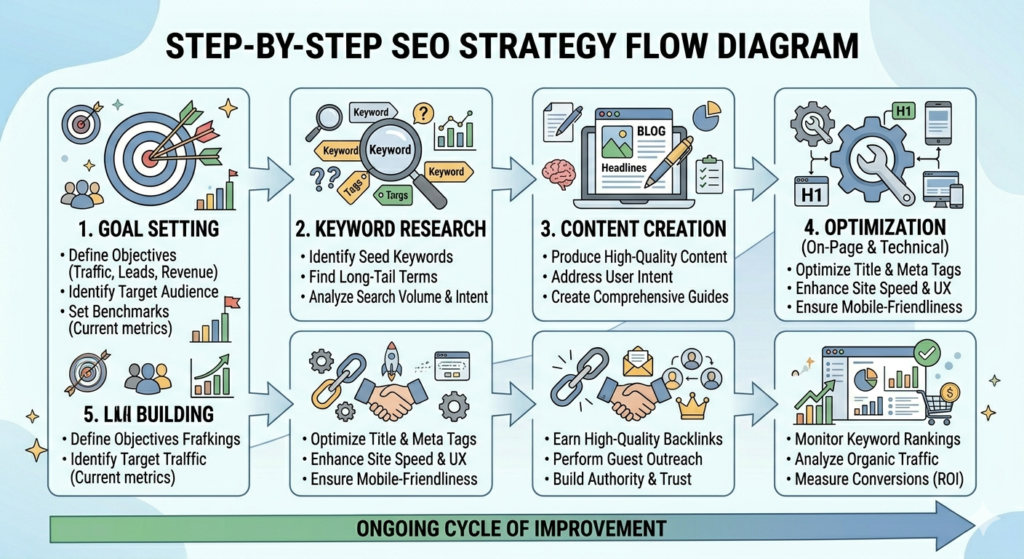
Every effective SEO strategy follows a clear sequence. Here it is, step by step.
1. Define Your Business Goals and SEO Objectives. Know precisely what success looks like. Is it 500 website visitors per month? 20 leads per week? Ranking on Page 1 for your primary keyword? Without a clear destination, you cannot plan a route.
2. Research Your Target Audience and Search Intent. Who are you trying to reach? What are they genuinely searching for? Tools like Google’s free Keyword Planner or even just the autocomplete suggestions in Google’s search bar can reveal exactly what your audience wants to know.
3. Analyse Competitors’ SEO Strategies. Who is already winning on Page 1? Study them carefully. What topics do they cover? How long is their content? How many backlinks do they have? You are not copying them you are understanding the standard you need to meet and exceed.
4. Optimise On-Page SEO and Content Strategy. Create content that is more comprehensive, more useful, and more clearly structured than anything currently ranking. Place your target keyword naturally in your heading, opening paragraph, subheadings, and image descriptions.
5. Build a Strong Technical SEO Foundation. Ensure your website loads fast, looks perfect on mobile, is secure, and is properly structured so Google can crawl and index every page.
6. Develop a High-Quality Link-Building Strategy. Earn backlinks through genuine value guest posts on relevant websites, partnerships with credible brands in your niche, digital PR, and content so useful that others naturally link to it.
7. Optimise for Local and Voice Search. If you serve a local market, claim and optimise your Google Business Profile, create location-specific pages, and write content that answers conversational voice queries.
8. Optimise for Mobile. Assume every visitor is on a phone. Test your website obsessively on mobile. Mobile usability is a direct ranking factor in Google’s algorithm.
9. Track Performance and Continuously Improve. Use Google Search Console and Analytics to track what is working. Review monthly. SEO is iterative the data always shows you where to go next.
Conclusion
There is a moment in every new website owner’s journey when they realise that having a great website is not enough, the world also needs to be able to find it.
That is the moment SEO becomes essential.
Understanding what is SEO in digital marketing truly means is understanding that you are not fighting for clicks, you are competing for trust. Google’s trust. Your audience’s trust. And the way to earn both is the same: create genuinely useful, well-structured, technically sound content that answers real questions for real people.
The three pillars: On-Page, Off-Page, and Technical SEO give you the framework. The objectives give you the direction. The benefits give you the motivation. And the strategy gives you the roadmap.
SEO is not a sprint. It is the marathon that every serious digital presence runs. And the beautiful thing about marathons is this: the people who finish are not always the fastest. They are the ones who started, stayed consistent, and never stopped.
Your marathon starts with one step. That step is your first optimized piece of content. You have already taken it by reading this. Now it is time to run.
Frequently Asked Questions
1. How to do SEO for beginners?
To understand what is SEO in digital marketing, start with keyword research, create helpful content and optimize your website pages. Focus on user experience, mobile-friendly design and consistency. SEO takes time, but small steps bring long-term results.
2. What are the 4 stages of SEO?
The 4 stages of SEO include research, optimization, building authority, and tracking performance. Once you understand what is SEO in digital marketing, these stages help you plan, execute and improve your strategy step by step
3. What is the golden rule of SEO?
The golden rule of SEO is simple: create content for people first, then optimize for search engines. It means focusing on value, relevance and trust rather than shortcuts or tricks.
4. Which practice of SEO is the best?
There is no single “best” practice, but combining on-page, off-page and technical SEO works most effectively.