
Imagine you are a small business owner.
You have a website, an Instagram page, a Google Ads campaign, a few blogs to write, leads to follow up with, and competitors to keep an eye on. You know digital marketing can bring customers, but there is one problem – there simply aren’t enough hours in the day to do everything.
Now imagine having an assistant that can help you research keywords, understand customer behaviour, create content ideas, analyse campaigns, identify patterns in your data, personalise communication and even automate repetitive tasks.
That is where artificial intelligence comes in.
AI is changing digital marketing from a process that often depends on manual work and assumptions into one that can be faster, more personalised and increasingly data-driven.
And in 2026, this change is becoming much more visible. Search itself is becoming conversational and AI-powered. Google says AI Overviews now have more than 2.5 billion monthly active users, while AI Mode has surpassed one billion monthly users.
So, what does all of this actually mean for businesses and digital marketers?
Let’s understand it in simple terms.
What Are the Pros and Cons of AI in Marketing?
Let’s go back to our business owner.
Earlier, she might spend three hours researching competitors, another two hours creating content ideas, and several more hours analysing campaign data.
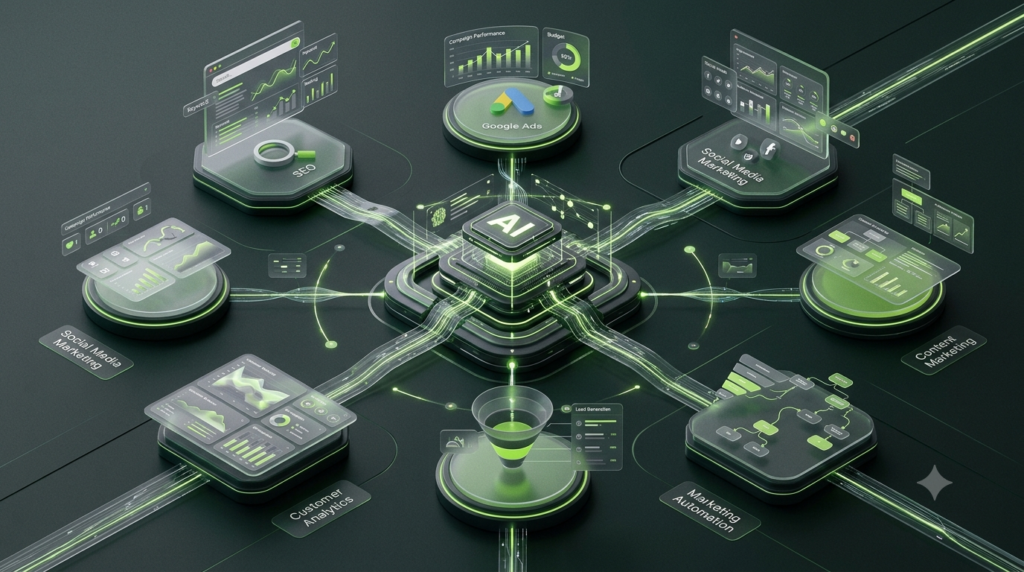
Today, AI is changing digital marketing by helping businesses complete many of these tasks faster, from research and content creation to campaign analysis and customer insights.
But that doesn’t mean AI is automatically the answer to every marketing problem. It works best when combined with the right strategy, human creativity, and a clear understanding of the business and its customers.
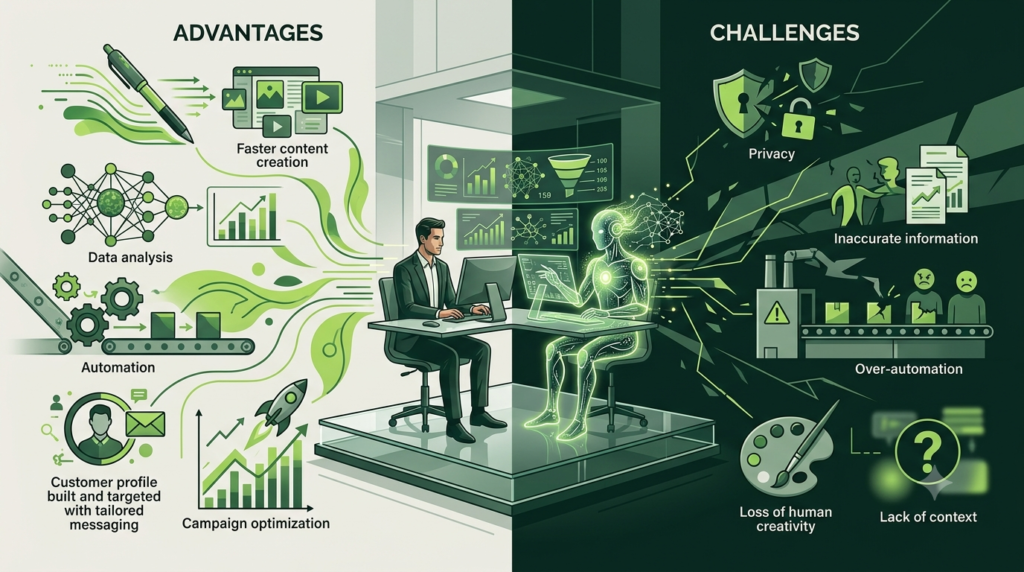
The Pros of AI in Marketing
1. It saves time
One of the biggest advantages of AI is simple: speed.
AI can help marketers brainstorm blog topics, summarise research, organise information, analyse large datasets and create initial drafts.
Instead of starting from a blank page, a marketer can start with a structured foundation and spend more time improving the strategy.
2. It helps understand customers
Marketing becomes much easier when you understand what your audience actually wants.
AI can analyse patterns in customer behaviour, searches, website interactions and campaign performance.
For example, instead of simply knowing that a campaign generated 500 clicks, AI-powered analysis can help identify patterns such as:
- Which audience engaged most?
- Which search terms generated quality leads?
- Which content attracted attention?
- Where are people dropping off?
- Which customers are more likely to convert?
This moves marketing from “I think this will work” towards “the data is showing us something.”
3. Personalisation becomes easier
Think about receiving an email that talks about exactly what you were looking for.
It feels more relevant than a generic message sent to everyone.
AI can help businesses create more personalised experiences by using customer and behavioural data to understand different audience segments.
This can be useful across email marketing, advertising, website experiences and customer communication.
4. Content creation becomes faster
AI can help marketers generate:
- Blog ideas
- Social media concepts
- Ad copy variations
- Email subject lines
- Video scripts
- Content calendars
- Product descriptions
But there is an important difference between using AI to create content and letting AI do all the thinking.
The strongest approach is often AI + human expertise.
5. Advertising is becoming more intelligent
Advertising platforms are increasingly using AI to automate parts of targeting, creative generation and optimisation.
For example, Google has continued expanding AI-powered capabilities across Search and advertising. Its AI Max for Search campaigns are designed to help advertisers discover additional relevant searches and use AI for targeting and creative capabilities.
For marketers, this means the job is gradually moving away from manually controlling every tiny setting and towards providing the right strategy, data, creative direction and business signals to AI systems.
But AI Has Its Cons Too
AI isn’t perfect.
It can produce incorrect information, misunderstand context, generate repetitive content or make recommendations based on incomplete information.
There are also concerns around:
- Data privacy
- Brand voice
- Over-automation
- Content quality
- Human creativity
- Accuracy and fact-checking
And perhaps the biggest danger is using AI without a strategy.
If you give AI poor information, you can get a polished version of a poor idea.
So the goal isn’t to replace marketing thinking with AI.
It is to use AI to make better marketing thinking possible.
What Are the Different Types of AI?
When people hear “AI”, they often imagine ChatGPT or a robot answering questions.
But AI in digital marketing is much broader.
You can think of it as different types of technology helping marketers perform different jobs.
Generative AI
This is the type most people are familiar with.
Generative AI can create new content based on instructions.
It can help create:
- Text
- Images
- Videos
- Ideas
- Scripts
- Emails
- Ad variations
For marketers, this can dramatically speed up the content creation process.
Predictive AI
Predictive AI looks at existing data and identifies patterns that can help businesses anticipate possible future outcomes.
For example:
“Which customers are more likely to purchase?”
“Which leads are more likely to convert?”
“Which campaign is showing stronger performance?”
It doesn’t magically know the future. Instead, it uses available data to identify patterns.
Conversational AI
Chatbots and AI assistants fall into this category.
Instead of making a customer wait for a business representative, an AI-powered assistant can answer common questions, provide information and sometimes help qualify leads.
Google is already experimenting with Business Agent for Leads in India, where an AI agent can interact with potential customers inside an ad and help answer questions and qualify leads.
Machine Learning
Machine learning allows systems to learn patterns from data and improve their predictions or decisions over time.
In digital marketing, machine learning can be used in areas such as:
- Audience targeting
- Recommendation systems
- Ad optimisation
- Customer segmentation
- Fraud detection
- Predictive analytics
AI Agents
This is one of the more interesting developments happening in 2026.
Traditional AI often waits for you to give it a prompt.
AI agents are increasingly being designed to perform multi-step tasks.
Google, for example, is expanding agentic capabilities across Search and its products, including information agents that can monitor information and provide updates.
For marketers, this could eventually mean moving from:
“AI, give me some ideas.”
to:
“Monitor my competitors, identify important changes and tell me what I should pay attention to.”
That is a significant shift.
Will AI Replace Digital Marketers?
This is probably the question every digital marketer has heard at least once.
“If AI can write blogs, create ads, analyse data and generate images, why do we need marketers?”
The answer becomes clearer when we change the question.
Instead of asking:
“Will AI replace digital marketers?”
ask:
“Which parts of digital marketing can AI replace or automate?”
That is a much more useful question.
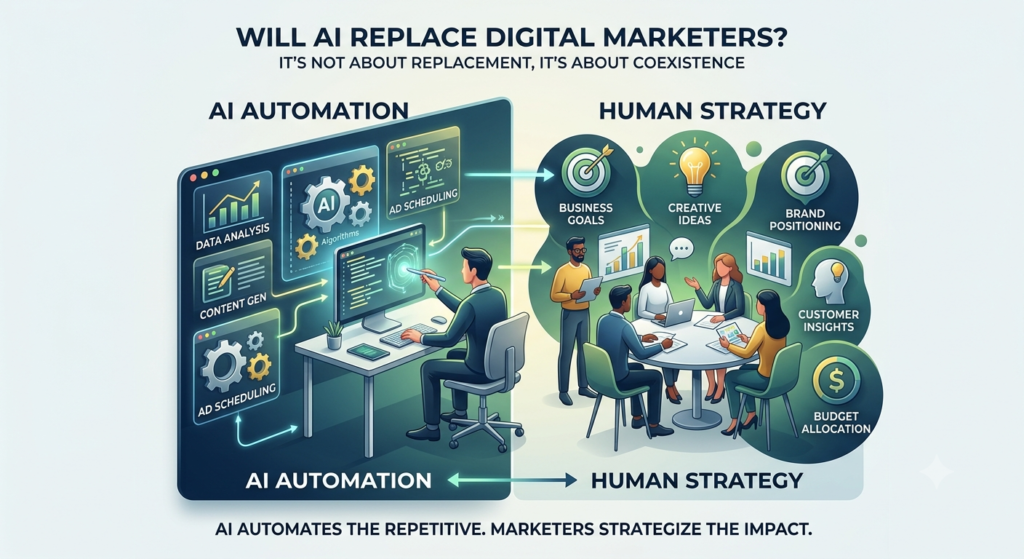
AI can automate repetitive tasks.
But marketing isn’t just about producing content.
Imagine a company selling premium apartments.
AI can help generate an advertisement.
But who decides:
- Who the ideal customer is?
- What makes the property different?
- What objections customers have?
- Whether Google Ads or Meta Ads should be prioritised?
- How much budget should be allocated?
- What offer should be communicated?
- Whether the leads are actually high quality?
- How the brand should be positioned?
Those decisions require business understanding, creativity, context and judgement.
AI can provide information.
A marketer turns that information into a strategy.
That’s why the role of the digital marketer is changing.
Instead of spending most of the day doing repetitive manual tasks, marketers can increasingly spend more time on:
Strategy → Creativity → Analysis → Decision-making → Customer understanding
In other words, AI may not remove the need for digital marketers.
It is changing what digital marketers need to be good at.
The marketer who knows how to combine AI, data, creativity and business strategy may work very differently from the marketer who relies entirely on manual processes.
What’s the Future of AI in Digital Marketing?
If you think AI has already transformed marketing, remember that AI is changing digital marketing in ways we are only beginning to understand in 2026.
One of the biggest changes is happening in search.
For years, marketers were trained to think about search in terms of keywords.
Someone searches:
“best digital marketing agency Bangalore”
and the marketer optimises a page for that keyword.
But people are increasingly asking longer, conversational questions.
Google reported that the average AI Mode search is around three times the length of a traditional Search query, showing how people are changing the way they search for information.
That means marketers need to think beyond individual keywords.
They need to understand:
What is the person actually trying to solve?
This is where helpful, trustworthy and genuinely useful content becomes increasingly important.
Search may become more conversational
People may ask:
“I run a small architecture business and want to generate leads without spending too much on advertising. What digital marketing strategy should I start with?”
That’s very different from searching:
“digital marketing for architects.”
The first question contains context, intent and a specific problem.
AI-powered search experiences are built to understand these kinds of conversations.
Marketing may become more personalised
Instead of showing exactly the same message to thousands of people, businesses can increasingly use AI to tailor experiences based on customer behaviour and intent.
Marketing automation may become more proactive
Today’s automation often means:
If X happens → do Y.
The future could involve AI systems monitoring information, identifying opportunities and recommending or performing appropriate actions within defined boundaries.
Creativity will become even more important
When everyone has access to tools that can generate content quickly, simply producing more content won’t necessarily create differentiation.
The question becomes:
What do you have to say that people actually care about?
That is where human experience, brand personality, storytelling and original ideas continue to matter.
Use AI to Boost Your Marketing Activities
You don’t need to build a complicated AI system to start.
You can begin with the marketing activities you’re already doing.
Start with content
Use AI to brainstorm:
- Content topics
- Customer questions
- Blog structures
- Social media ideas
- Video hooks
Then add your own experience and expertise.
Use AI for SEO research
AI can help organise keyword ideas, understand search intent, identify content gaps and structure topics.
But don’t blindly publish whatever AI generates.
Review the information, add original insights and make the content genuinely useful.
Improve your advertising workflow
AI can help generate multiple ad copy variations, analyse campaign data and identify patterns.
Google is also introducing more AI and agentic capabilities into Google Ads and Google Analytics to help marketers identify insights and act on them faster.
Automate repetitive tasks
Think about everything you repeatedly do every week.
Maybe it is:
- Sending follow-up emails
- Reporting campaign performance
- Organising leads
- Creating content briefs
- Updating spreadsheets
- Summarising meetings
- Tracking competitors
Some of these activities can potentially be automated.
The important question isn’t:
“Where can I use AI?”
Ask:
“What is taking too much of my time that AI could help me simplify?”
That’s where the real value begins.
Conclusion: AI Is Changing Digital Marketing – But Strategy Still Matters
A few years ago, AI in marketing sounded like something that belonged in the future.
Today, it is already influencing how people search, how businesses advertise, how marketers create content and how customers interact with brands.
AI is changing digital marketing by making marketing more automated, personalised, conversational and data-driven.
But there is one thing AI cannot replace easily:
understanding the business behind the marketing.
A tool can generate an advertisement.
A marketer needs to understand why that advertisement should exist in the first place.
A tool can analyse data.
A marketer needs to decide what action that data should lead to.
A tool can generate content.
A marketer needs to understand whether the content actually connects with the customer.
The future isn’t necessarily AI vs marketers.
It is increasingly about marketers who know how to use AI effectively.
And for businesses, the opportunity is similar.
You don’t need to adopt every new AI tool.
You need to identify where AI can help you save time, understand customers better, improve your marketing decisions and ultimately generate better business results.
Ready to Make AI Work for Your Marketing?
If you’re looking to improve your online visibility, generate quality leads and build a more data-driven marketing system, I can help.
I work across SEO, Google Ads, social media marketing, performance marketing, website development and AI-powered marketing automation to create strategies based on your business goals – not just trends.
Whether you’re a startup, service-based business or growing brand, the goal is simple:
Reach the right audience. Build visibility. Generate quality leads. Turn attention into revenue.
👉 Explore my digital marketing services and let’s grow your business:
Mahimavathi Katta – Digital Marketing Services